|
|
|
| |

|
|
ICCAT Newsletter
June 2026
|
|
|
|
|
|
| |
|
Dear Readers and Tuna World Friends:
 In this sixtieth anniversary year, ICCAT is pleased to pay heartfelt tribute to all those who have supported its continuous progress since its beginnings. From 17 Contracting Member States at its creation in 1966, ICCAT now has 56 Contracting Parties and 4 Cooperating Non-Contracting Party, Entity or Fishing Entity. This reflects the commitment of these States in joining their efforts, alongside many partners, for the conservation and management of tuna and tuna-like species in the Atlantic Ocean and its adjacent seas. In this sixtieth anniversary year, ICCAT is pleased to pay heartfelt tribute to all those who have supported its continuous progress since its beginnings. From 17 Contracting Member States at its creation in 1966, ICCAT now has 56 Contracting Parties and 4 Cooperating Non-Contracting Party, Entity or Fishing Entity. This reflects the commitment of these States in joining their efforts, alongside many partners, for the conservation and management of tuna and tuna-like species in the Atlantic Ocean and its adjacent seas.
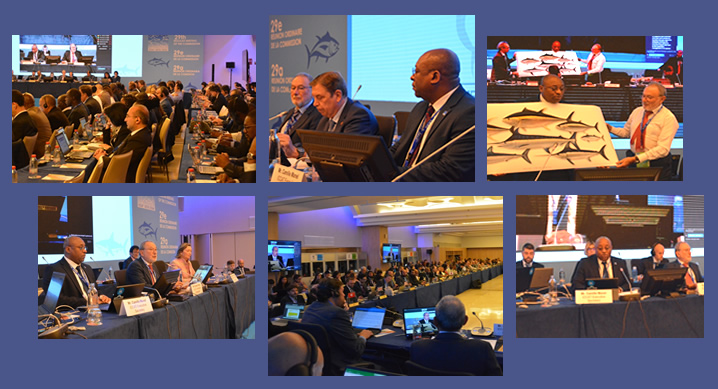
True to this commitment, the Commission concluded the year 2025 with its Annual meeting in Seville, Spain (17–24 November 2025), during which further progress and important decisions were once again recorded, following intense discussions and negotiations supported throughout the meeting by the advice of the SCRS.
Among other major decisions, the Commission increased the total allowable catch (TAC) for Atlantic bluefin tuna by 13% for the western stock and by 19.3% for the eastern stock for the 2026 to 2028 period, based on the current management procedure (MP); the Commission also adopted a MP for western Atlantic skipjack for the 2026–2028 period, set a maximum mortality target of 1,000 tonnes for southern Atlantic porbeagle shark, and prohibited the retention on board, transhipment or landing of basking sharks (Cetorhinus maximus) and great white sharks (Carcharodon carcharias).
The Commission’s Compliance Committee conducted a thorough review of CPC compliance and agreed on a procedure aimed at improving its effectiveness. Finally, the Commission further strengthened its commitment to preparing for the implementation of the BBNJ Agreement through a new resolution and proceeded with the election of its Officers, including, for the first time, elected Vice-Chairs.
Ms Zakia Driouich (Morocco) was elected as the new Commission Chair, and paid tribute to the outgoing Officers.
The important conclusions of the Annual meeting have enabled a very demanding work schedule for the various subsidiary bodies for the 2026 intersessional period. Many of these bodies, in line with the Commission’s guidance, have already begun their work, which has also benefited from contributions from partners. Likewise, the various ongoing projects aimed at improving science, compliance and capacity building, among other things, are making progress, which we invite you to follow in this Newsletter.
All these achievements, the result of the efforts made over these 60 years of existence, strengthen our conviction that the cooperation of all Member States, with the support of partners within ICCAT, will continue to maintain populations of tuna and tuna-like species in the Atlantic Ocean at levels that allow the achievement of maximum sustainable yield for food and other purposes, while conserving biodiversity and ecosystems.
We hope you enjoy reading this 42nd issue of the ICCAT Newsletter.
See you soon! |

Executive Secretary
|
 |
|
|
|
|
|
|
Introduction
|
|
During the 29th Regular Meeting of the Commission, held in Seville, significant progress was achieved across several key areas:
Bluefin tuna quotas (2026–2028):
Increased catch limits to 3,081.6 tonnes (western Atlantic) and 48,403 tonnes (eastern Atlantic)
Skipjack tuna management:
Introduction, for the first time, of a fixed TAC of 30,844 t in the western Atlantic
Shark conservation:
Implementation of a 1,000 t mortality cap for shortfin mako and a ban on retaining basking and great white sharks
Support for Developing States:
Limited catch allowances for blue marlin (20 t) and white marlin/spearfish (10 t)
Compliance and control:
Enhanced monitoring, port inspections, and enforcement against IUU fishing
Biodiversity:
New resolution to advance implementation of the BBNJ Agreement
Aquaculture pilot project:
Assessment of the feasibility of farming bluefin and yellowfin tuna in the Canary Islands
 |
Hotel Meliá Sevilla hosted the 29th Regular Meeting of the Commission (Seville, Spain)
|
Recommendations and Resolutions
During the 29th Regular Commission Meeting, ICCAT brought together a broad and active participation. The meeting was attended by over 500 in-person delegates and almost 200 remote participants, representing 53 Contracting Parties, 4 Cooperating Non-Contracting Parties, 7 intergovernmental organizations, one Non‑Contracting Party, and 33 non-governmental organizations.
At the conclusion of the Meeting, the Commission adopted a total of 12 new Recommendations and three new Resolutions, reflecting continued progress in the conservation and management of tuna and tuna-like species, as well as in strengthening monitoring, compliance, and international cooperation. These are as follows: |
In accordance with Article VIII of the ICCAT Convention and providing no objections were lodged, the Recommendations will enter into force on 18 June 2026. The texts of the above referenced documents are available on the ICCAT website.
|
|
|
|
|
|
|
Past Assessments, Meetings & Workshops
|
|
 |
|
Since the last Newsletter of November 2025, several stock assessments (shortfin mako shark; white marlin and bigeye tuna) were conducted and the many Commission and SCRS meetings were held, as well as several Workshops. In addition, all the Executive Summaries of species have been updated and are available here.
Commission and SCRS Meetings
| Feb |
Meeting of the Ad Hoc Working Group on Coordination of Tagging Information
3 Feb, Online
Meeting of the Port Inspection Expert Group for Capacity Building and Assistance (PIEG)
4 Feb, Online
First Meeting of the Standing Catch Document Scheme Working Group (CDS WG)
5 Feb, Online
Working Group on Online Reporting Technologies Meeting (WG ORT)
10-11 Feb, Online
Intersessional Meeting of the Subcommittee on Statistics (SC-STATS)
24-25 Feb, Online
|
|
| Mar |
Intersessional Meeting of Panel 2
3-5 Mar, Hybrid, Madrid, Spain
First Intersessional Meeting of the Bluefin Tuna Species Group
9-12 Mar, Online
Swordfish Data Preparatory Meeting
23-27 Mar, Hybrid, Madrid, Spain
First Intersessional Meeting of Panel 1
30 Mar, Online
First Meeting of the Virtual Working Group on a Sustainable Financial Position for ICCAT (VWG-SF)
31 Mar, Online |
|
| Apr |
Albacore Data Preparatory Meeting
13-17 Apr, Hybrid, San Sebastián (Pasaia), Spain
Intersessional Meeting of the Tropical Tunas Species Group (including MSE)
20-22 Apr, Hybrid, Madrid, Spain(
Meeting of the Standing Working Group on Dialogue between Fisheries Scientists and Managers (SWGSM)
27 Apr, Online |
|
| May |
Second Intersessional Meeting of Panel 1
5-7 May, Hybrid, Bilbao, Spain
Meeting of the Subcommittee on Ecosystems and Bycatch
18-22 May, Hybrid, Madrid, Spain
Working Group on Stock Assessment Methods Meeting (WGSAM)
25-28 May, Hybrid, Madrid, Spain |
|
| Jun |
Intersessional Meeting of the Compliance Committee
1-5 Jun, Hybrid, Brussels, Belgium
Electronic Monitoring Systems Working Group (EMS WG) Meeting
1-5 Jun, Hybrid, Brussels, Belgium
19th Meeting of the Working Group on Integrated Monitoring Measures (IMM)
1-5 Jun, Hybrid, Brussels, Belgium
North Atlantic Shortfin Mako Stock Assessment Meeting (including BSH MSE)
8-12 Jun, Hybrid, Lisbon, Portugal
Second Meeting of the Virtual Working Group on a Sustainable Financial Position for ICCAT (VWG-SF)
15 Jun, Online
Albacore Stock Assessment Meeting
22-25 Jun, Hybrid, Madrid, Spain
|
|
|
|
Seminars & Workshops
|
|
|
|
|
|
|
|
2026 Calendar of events

|
|
|

Commission Meetings
| Jul |
Intersessional Meeting of Panel 4
7-8 Jul, Online
|
|
| Sep |
Second Meeting of the Standing Catch Document Scheme Working Group (CDS WG)
2-3 Sep, Online
|
|
| Nov |
Third Intersessional Meeting of Panel 1
14-15 Nov, Hybrid, Vilamoura, Portugal
25th Special Meeting of the Commission
16-23 Nov, Hybrid, Vilamoura, Portugal |
|
SCRS Meetings
| Jul |
Second Intersessional Meeting of the Bluefin Tuna Species Group
1-4 Jul, Hybrid, Nara, Japan
Swordfish Stock Assessment Meeting
13-17 Jul, Hybrid, Madrid, Spain |
|
| Sep |
Species Groups and Subcommittee on Statistics (SC-STATS) Meetings
14-19 Sep, Hybrid, Madrid, Spain
SCRS Plenary Meeting
21-25 Sep, Hybrid, Madrid, Spain |
|
|
|
|
|
|
| |
| |
| |
|
|
| |
Other Scientific Activities
|
|
| |
GBYP
GBYP Phase 14 was successfully completed in December 2025. The main results of the activities carried out along 2025 are summarized below. Phase 15 started in February 2025, and will run for 23 months (until December 2027).
Highlights from September 2025 and expected achievements for 2026 are summarized below. These are critical to refining stock assessments and strengthening science-advice for management of Atlantic bluefin tuna:
 |
|
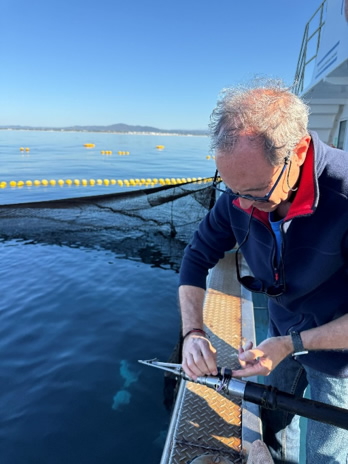
Pole applicator for the underwater deployment of acoustic tags on bluefin tuna (off southern Portugal, May 2026).
|
|
- Data Systems: Significant developments were made on the biological and electronic tagging information systems (databases) stored the ICCAT Secretariat infrastructure. The ETAGS database will be fully operational by the end of the year with the upload of all the tracking data.
- Aerial Surveys: The eastern stock abundance index time series was updated incorporating the results from 2025 survey carried out in the western Mediterranean (Balearic Sea). A new aerial survey is planned for June 2026, together with additional standardization work of the index for accounting for environmental variability and the modelling tasks to get an improved index time series has been initiated.
- Tagging: Five new MoUs to deploy up to 110 electronic tags in the Mediterranean and Eastern Atlantic (70 archival tags and 40 acoustic transmitters) have been signed. The first acoustic tagging campaign took place off the southern cost of the Algarve (southern Portugal).
- Biological Studies: New genetic studies have been completed under Phase 14, which contributed to improving the knowledge on bluefin tuna population’s structure, as well as on mixing dynamics of Atlantic populations. Further studies to develop new tools (epigenetic clocks) for ageing have been initiated.
- Modelling: Two studies aimed at testing the impact of new information on absolute biomass of western bluefin tuna stock and on potential impact on the periodicity of abundance indices derived from aerial surveys on management strategy evaluation (MSE) were completed under Phase 14. A new contract has been awarded in 2026 to perform a bluefin stocks status/health check.
|
Additional information can be found here. |
ALBYP
Significant progress has been made regarding biology, movement, and management strategy evaluations (MSE).
Reproduction and Growth:
- A new contract on albacore reproduction in the North Atlantic has been signed, aiming at the conclusion of the study during 2026.
- For the South Atlantic a new contract has also been signed with a research team from Brazil to proceed with processing and analyses of new samples collected (by Brazil, Namibia, South Africa, and Chinese Taipei), which will allow the conclusion of the study in 2027.
- Preliminary results from ongoing studies have shown possible bias when estimating growth parameters based on readings from spine samples. Further research is needed, which shall include samples from juveniles.
- A new study has estimated ages of up to 18 years for albacore tuna, with at least one estimate validated using bomb-radiocarbon (14C). Despite these findings, the maximum age of 15 years will be maintained for the assessment, until further results from an ongoing ICCAT contract become available.
Movements & Habitat Use:
- Over 270 electronic tags have been deployed, of which 73 have transmitted data and/or were recovered. Of those, 225 corresponded to internal archival tags, of which 21 were recovered in 2025).
- New campaigns are planned from June to December 2026, in both the North and South Atlantic, aiming at albacore electronic tagging.
Management Strategy Evaluation (MSE):
- A new MSE process is ongoing for the South Atlantic albacore, with preliminary Operating Models (OMs) and preliminary projections testing of six Candidate Management Procedures (CMPs), were recently presented to the SCRS.
- For the North Atlantic, the Commission has requested the SCRS (via Panel 2 March meeting) further investigations, which recently discussed three CMP types. The plan for this MSE involves improving the index-based parameters, conducting thorough robustness testing, and updating the Trial Specification Document.
- A new potential Exceptional Circumstances Protocol (ECP) affecting the MP will be reassessed by the SCRS in September 2026, to take into account the 2025 data.
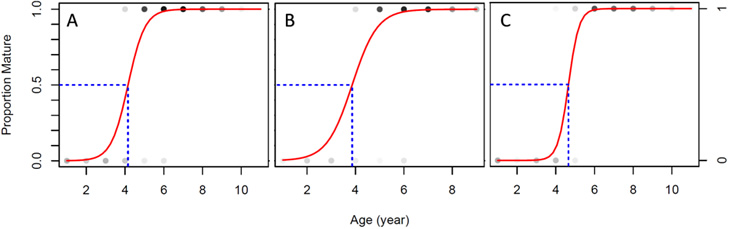 |
Preliminary results regarding the proportion of mature individuals by age for (A) sexes combined, (B) females and (C) males for the northern Atlantic albacore.
|
Additional information can be found here. |
|
SMTYP
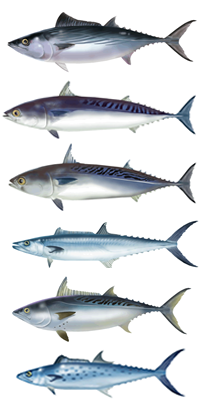
Since 2018, this programme has coordinated biological sampling of small tunas - little tunny (LTA), Atlantic bonito (BON), and wahoo (WAH), bullet (BLT) and frigate (FRI) tuna, among other species. The current contract engages a consortium of 20 entities from 13 Contracting Parties.
Objectives:
- Fill size gaps for growth and maturity estimates for BON, LTA, WAH and collecting additional samples for FRI and BLT in the Atlantic and the Mediterranean Sea.
- Determine growth and reproduction parameters for BON, LTA, WAH, FRI, and BLT.
- Refine stock structure analyses for BON, LTA, WAH, FRI and BLT species.
- Investigate genetic differentiation between FRI and BLT.
|
|
|
Results and updates have been presented during intersessional meetings. Priorities for 2026–2029 include:
- The update of the biological meta-database and the new biological sampling is ongoing, as well as the estimation of length–weight relationships at stock/regional levels.
- New advances have been presented regarding the bullet and frigate tuna, with preliminary genetic results suggesting that the bullet tuna is the dominant species on temperate waters of the Northeastern Atlantic and the Mediterranean Sea, with an increasing level of mixing towards the tropical waters, namely in the Gulf of Guinea. There is also a high level of misidentification, due the resemblance of the two species.
- Growth parameters have been presented for the LTA, BON, and WAH species. Work is currently underway to establish a reference dataset for these species.
- A specific working group has been created to develop data-limited methods for management advice.
- The coordination and management tasks have been reinforced with the enhancement of the ICCAT Secretariat support to these SMTYP tasks.
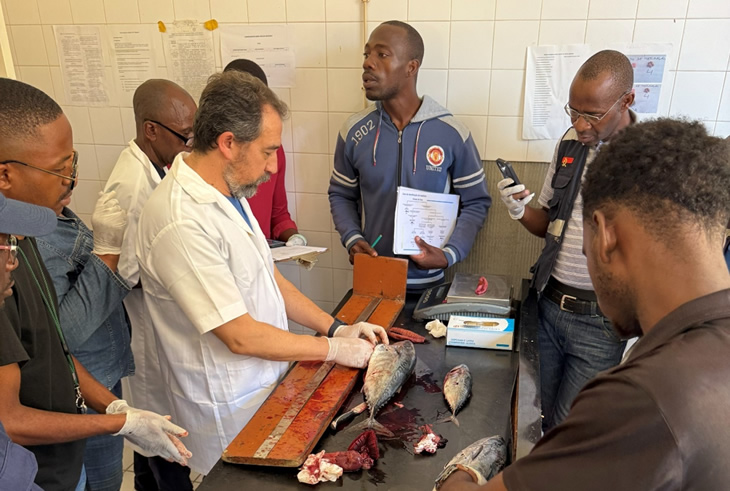 |
Capacity-building on small tuna species identification and collection of biological samples in Angola.
|
Additional information can be found here.
|
EPBR
This programme was originally designed to collect catch/effort data and support tagging and ageing studies, the programme has since expanded to include habitat use and migrations and spawning.
Key highlights:
- Sample collection: Since 2019, 781 biological samples of BUM, WHM, and SFA have been collected in the eastern Atlantic, by teams from West Africa countries and EU-Portugal. A bomb-radiocarbon validation study is ongoing for blue marlin using otoliths, with preliminary results supporting current age estimations. Sample collection, ageing and bomb-radiocarbon work will continue throughout 2026.
- Tagging: Since 2023, satellite and conventional tagging has been carried out in the eastern Atlantic, with 11 white marlins and three blue marlins tagged off the southern Portuguese coast and two sailfish tagged off São Tomé e Príncipe, plus 31 conventional tags deployed on white marlins. Preliminary results point to important large-scale transatlantic and inter-hemispheric migrations. Tagging campaigns will continue throughout 2026.
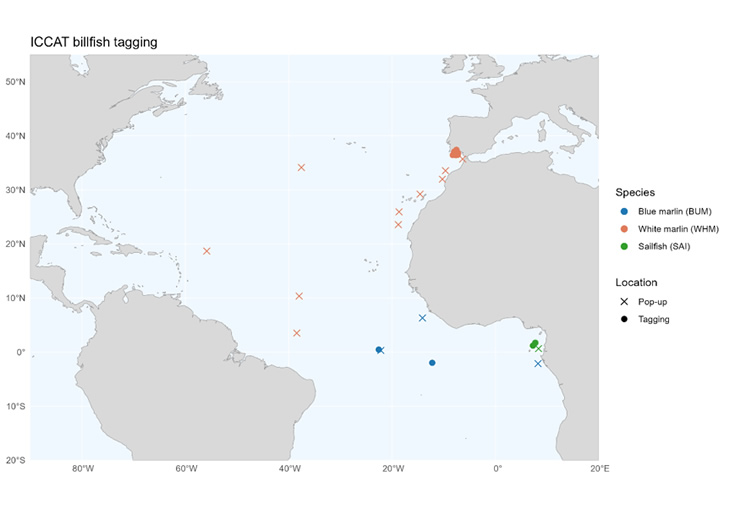 |
Location of electronic tags deployment and tag pop-up for the three billfish species.
|
Additional information can be found here. |
SRDCP
The Shark Species Group advanced key studies since the last Newsletter, including those regarding the following:
Age & Growth:
- The collaborative study on South Atlantic shortfin mako allowed to provide relevant input for the 2025 Stock Assessment for the southern Atlantic stock.
- Age validation work is ongoing, including a study based on bomb radiocarbon techniques, to validate the growth band deposition periodicity throughout the lifespan and early growth of shortfin mako shark.
- Age and growth research also progressed for longfin mako, with vertebrae processing, and the collection of images and age readings underway.
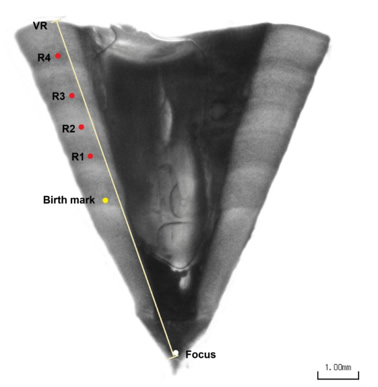 |
Sagittal section of a vertebral centrum of a shortfin mako (Isurus oxyrinchus) shark female (fork length: 154 cm) from the South Atlantic. The yellow dot marks the birth mark and the red dots indicate each growth band. (Source: Márquez et al., 2025, document SCRS/2025/040). |
- Genetics: Porbeagle genetics studies proceeded to further investigate the connectivity between the southeastern and southwestern Atlantic, as well as between the southern Atlantic and the Indian Oceans.
Tagging & Movements:
- Shortfin mako: Post-release mortality analysis has been updated, showing that 28% of the 128 shortfin mako sharks tagged with satellite tags died soon after being discarded live by pelagic longlines. The results have been incorporated in the South (2025) and North (2026) Shortfin Mako Stock Assessments. These results are also useful to respond to the Commission request on the retention allowance for shortfin mako.
- Other sharks: After the successful dedicated tagging campaigns in 2024 and 2025, which resulted on the deployment of 31 pop-up tags (including 12 silky sharks, 3 bigeye threshers, 2 longfin makos, 2 smooth hammerheads, 11 oceanic whitetip and 1 blue shark) in the equatorial area of the Atlantic, new tagging campaigns are underway on both eastern and western Atlantic areas.
- As part of a pilot project, mini data loggers (TDRs) have been deployed on the mainline and on the branchlines of longline fishing vessels, to register profiles of depth and depth/temperature for the operation of the longline gear, which have potential interactions with shortfin mako sharks.
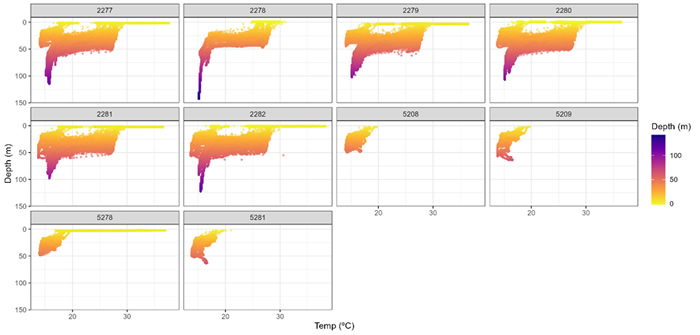 |
Example of temperature records by depth intervales (coloured), collected by the TDRs deployed on longline gear.
|
These efforts are refining knowledge on shark biology, stock boundaries, habitat use, and mortality, and directly supporting more robust scientific advice aiming the adoption of conservation and management measures by ICCAT.
Additional information can be found here. |
|
SWOYP
Launched in 2018, SWOYP brings together 23 institutions from 15 CPCs to reduce key uncertainties in swordfish biology and improve stock assessments and the MSE process. The programme focuses on ageing and growth, reproductive biology, genetics, and tagging, with nearly 4,900 swordfish samples collected across all three ICCAT-managed swordfish stocks.
- Age & Growth: New results have been presented for both northern and southern Atlantic stocks, which will be used during the ongoing Stock Assessment for the southern Atlantic stock. Age validation via bomb radiocarbon analysis remain underway, to help refine maximum age estimates and the catch-at-age data used by the SCRS on the provision of advice.
- Reproduction & maturity: Similarly, the achieved results recently presented to the SCRS allowed the size of maturity (L50) to be updated and will also be used during the ongoing Stock Assessment.
- Genetics: Additional work is underway on stock differentiation, identification of boundaries and mixing rates among the three swordfish stocks (ATL-N, ATL-S and MD). Available results showed a clear genetic separation between Mediterranean and Atlantic stocks, as well as differentiation between North and South Atlantic groups with evidence of mixing in the BIL94B area. These results are essential to address critical uncertainty in Atlantic swordfish science and management.
- Tagging: 56 satellite tags have been deployed since 2018 across the Atlantic and Mediterranean; recent campaigns in the north-eastern Atlantic and off Newfoundland have expanded knowledge of migration, stock mixing, and vertical habitat use. New tagging campaigns are scheduled for this summer.
- Fisheries: Following the Commission requests several Contracting Parties (EU-Portugal and EU-Spain; Japan), have reported preliminary results to the SCRS, on their ongoing studies regarding the use of traplines on pelagic longline fisheries. These reported the first quantitative evidence that traplines show differences in catch composition and catch per unit effort (CPUE) compared to standard pelagic longline gear used for targeting swordfish.
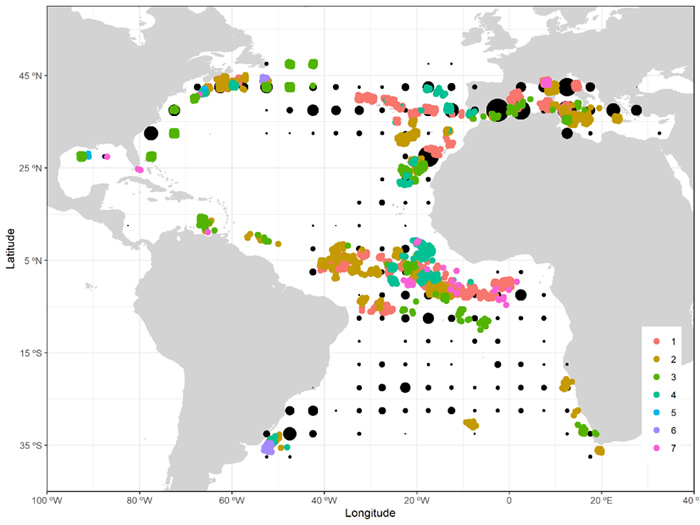 |
Swordfish sampling coverage for the North and South Atlantic, and Mediterranean Sean. Black dots represent swordfish catch for years 2019-2023 for each 5°x5° grid cell area, scaled by contribution to the overall catch. Coloured dots represent biological sample collection locations for phases 1 to 7 of SWOYP. Sampling locations have been jittered by 0.5°x0.5°.
|
Additional information can be found here. |
TTRaD
This programme, which was launched in 2024, supports ICCAT tropical tuna management through data collection, tagging, age and growth studies, and MSE developments. In 2025, TTRaD focused on improving scientific advice, updating spatio-temporal models, and maintaining the Atlantic Ocean Tropical Tuna Tagging Programme (AOTTP) database.
Key Achievements:
- MSE & Stock Assessment: After the implementation of the western skipjack MP, the ongoing work relates to the development of an ECP.
- The development of the tropical tuna multi-stock MSE is underway, with the most recent work focusing on the observation error model and options for Harvest Control Rules (HCR) to simulate TAC and fleet effort adjustments.
- Age & Growth Studies: A joint-ICCAT-iTUNNES workshop was recently held in Pasaia (Spain) to advance current knowledge on age and growth and partially on reproduction of the three tropical tunas species (bigeye, yellowfin and skipjack). This collaborative and coordinated action aims updating growth parameters, and identify major data gaps and priority needs for future work, aiming the reducing uncertainty on the key parameters for the provision of scientific advice to the Commission.
- Fisheries statistics: Following recent discussions and concerns regarding the tropical tuna reported catches, the SCRS has set an ad hoc sub-group tasked with reviewing the tropical tuna catch composition and ICCAT Task 1NC statistics. The first report is planned to be provided during the September 2026 Species Group meeting.
These activities have helped to improve the data available to support future tropical tuna assessments and the development of the MSE processes, hence the SCRS advice to the Commission.
Additional information can be found here.
|
|
|
|
| |
Other Activities
|
|
| |
Voluntary Contributions

Since the last Newsletter (November 2025), the ICCAT Secretariat has received notification that during 2026 the following voluntary contributions will be made:
|
Currently, the ICCAT Secretariat is in the process of signing four contracts with the European Union:
- 2026 and 2027 Science programme: A voluntary contribution of €1,060,000.00 (contract amount (€1,420,425.00).
- ICCAT GBYP, Phase 15: A voluntary contribution of €750,000 (contract amount (€1,194,655.00).
- Contribution towards the organization of the 25th Special Meeting of the Commission: A voluntary contribution of €600,000.00 (contract amount (€811,184.23).
- Analysis of reporting obligation: A voluntary contribution of €100,000.00 (contract amount: €125,000.61).
ICCAT has three active grant agreements with the European Union, including the following:
- IOMS: The voluntary contribution of the European Union amounts to €150,000; (contract amount €188,187.32) to support the IOMS development.
- Integration of the UN/FLUX standard into the IOMS: The voluntary contribution of the European Union amounts to €100,000.00; (contract amount €125,321.26), to support this specific IOMS component.
- ICCAT: Contribution to the organisation of ICCAT intersessional meetings and other Working and Technical Groups (2025/2026). The voluntary contribution of the European Union amounts to €240,000.00; (contract amount € 312,500,01).
United States will contribute with €220,400.00 to cover part of the SCRS activities for 2026 related to:
- The Subcommittee on Statistics (€90,000.00) (continuation of Phases II and III of the Caribbean Project);
- Billfish (Enhanced Programne for Billfish Research (EPBR)) (€38,400.00);
- Tropical Tunas (TTRaD) (€42,000.00) (Funding for the tagging offices, implementation of the ICCAT Roadmap for Multi-stocks MSE for western skipjack established by the Commission and Age-growth-reproduction Workshop); and
- The Working Group on Stock Assessment Methods (WGSAM) (€50,000) (Training Workshop Bycatch Estimation Tool (BYET) and additional BYET development to incorporate the possible feedback of 2025 training workshops).
A contract has been signed with Canada to finance the GBYP, SRDCP and SWOYP (CAD $93,000):
- Satellite tagging: Contribute to tagging research, including electronic database development and genetics, and analysis of western Close-Kin Mark-Recapture (CKMR) samples collected from commercial fishing operations in the western Atlantic (CAD $33,000);
- Sharks Research and Data Collection Programme (SRDCP) (CAD $30,000) (Satellite tagging: Continue studies on species distribution, migrations, habitat use, and post-release mortality for priority species (shortfin mako, longfin mako, oceanic whitetip, silky shark, bigeye thresher, hammerheads, porbeagle and blue shark), through satellite tagging);
- SWOYP (CAD $30,000) (Satellite tagging work: Continue ongoing work prioritizing stock mixture area of the Northeast Atlantic and investigation of range shifts in the northwestern Atlantic, as well opportunistic tagging in other areas, including the Southwest Atlantic, equatorial region and the Mediterranean).
China (P.R.) will contribute with €40,000.00 to finance part of the tropical tunas (TTRaD) activities:
- Annual collection of samples and update of parametres of three species according to gaps.
- Validation of age for skipjack and age-growth-reproduction workshop.
Further to the agreement signed with the FAO-led Common Oceans ABNJ-2, and a fourth voluntary contribution received (€115,056), the ongoing activities include:
- improved compliance with ICCAT conservation and management measures, namely through strengthening of port inspection capacity;
- supporting the centralised management of online data reporting, validation, storing and access;
- generating ecosystem-based OMs for the testing of ecosystem indicators and management policies;
- coordinating common objectives and communicating key messages on the development of fishery management, in particular in the context of ongoing BBNJ discussions and the United Nations Agreement on Fish Populations.
|
ICCAT/Japan Capacity-Building Assistance Project (JCAP-3)
As part of the new JCAP-3, since the last Newsletter, a number of training programmes and capacity-building activities have been carried out with the aim of strengthening national capabilities in fisheries monitoring, species identification, data collection and scientific research.
- Gabon – Capacity-building workshops for the fisheries departments of Port-Gentil and Mayumba were rescheduled for 2026 due to the political situation at the start of 2025. These workshops will support data collection from artisanal fisheries, species identification and the reporting of information.
- Angola – Two capacity-building courses were delivered:
- Species identification and basic concepts related to sampling and fisheries data collection, covering two main components:
- identification of major tuna, small tuna and other bycatch species caught and retained by artisanal fishermen, and
- theory on how to establish and implement a sampling strategy to improve routine catch data collection (including size), effort data and biological information on ICCAT species, and
- Improved knowledge regarding ICCAT reporting obligations of local fisheries officials and preparing a sampling programme targeting ICCAT species.
- Guinea (Rep.) – As part of the first year of the ICCAT/JCAP-3 Programme, the Guinea (Rep.) received financial support to strengthen its monitoring system for artisanal fisheries, primarily for small tuna, at six landing points. The objectives of this project are:
- Improve knowledge of the tuna species exploited by artisanal fishermen along the coast, landings from artisanal and semi-industrial fisheries, and to report fisheries statistics to ICCAT;
- Strengthen institutional capacities to regulate, monitor and control tuna fisheries;
- Improve the collection of data on tuna fisheries and its scientific analysis; and
- Ensure Guinea (Rep.)’s compliance with its regional and international commitments.
- Nigeria – In 2026, thanks to funding from the ICCAT/JCAP-3 programme, the Federal Department of Fisheries and Aquaculture of Nigeria will proceed with the implementation of three new capacity-building course for fisheries officials and local fishermen in the states of Ondo, Delta, and Cross River. The objective is to keep enhancing local capacity following the 2025 activities, and to ensure wider national coverage, which aims to develop essential skills in data collection and reporting, species identification and sustainable fishing practices.
|
|
|
|
|
|
|
| |
|
|
|
|
| |
|
|
| |
Staff News |
|
| Mr Jesús Moreno joined ICCAT as Software Developer (IOMS) in May 2026. |
 |
|
Mr Ousainou Jaiteh left the Department of Statistics as Software Developer (IOMS) in May 2026. The ICCAT Secretariat would like to wish Mr. Jaiteh great success in his new career.
|
|
|
|
|
|
|
|
|
|
|
|
✉️ Feedback & suggestions
Should you detect any errors or wish to provide any suggestions for improvement in this Newsletter, please inform us by
e-mail →
 |
ICCAT · ICCAT Newsletter · © 2026 |
|
|
|